The Captain's Guide to Practice Planning for Ultimate Frisbee
Why Most Ultimate Practices Are Wasted Time
Here's a harsh truth: most ultimate frisbee practices don't make teams better. They make them more fit, sure — but running drills without a plan is like throwing a disc without a target. You're moving, but you're not going anywhere.
The teams that improve fastest are the ones that treat practice like preparation, not just exercise. Every session should have a purpose, a structure, and a connection to what you're building toward on game day.
The Framework: Plan, Execute, Review
Great practices follow a simple loop: plan what you're going to work on, execute with intention, and review what happened. Most teams skip the first and third steps entirely.
Planning (Before Practice)
Before your team touches a disc, answer three questions:
- What's our focus? Pick one or two skills, concepts, or systems. Not five. Not "everything." One or two.
- What drills support that focus? Choose drills that isolate the skill, then drills that apply it in game-like situations.
- How will we know it worked? Define what success looks like — not just "we did the drill," but "our cutters are timing their cuts earlier."
Share the plan with your co-captains before practice so everyone is aligned.
Execution (During Practice)
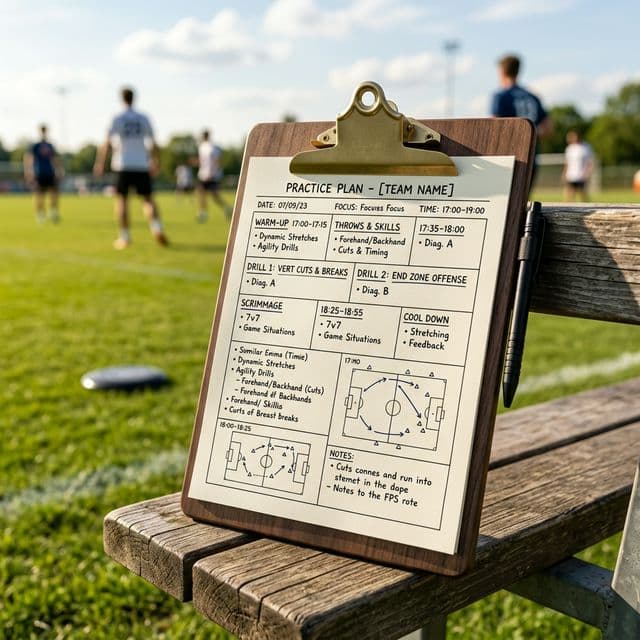
A well-structured two-hour practice might look like this:
- 0:00–0:15 — Warm-up and throwing (dynamic stretches, partner throws with purpose)
- 0:15–0:45 — Drill block 1 (isolated skill work: cutting timing, break throws, defensive positioning)
- 0:45–1:00 — Water break and walk-through (explain how the skill connects to your system)
- 1:00–1:30 — Drill block 2 (game-like scenarios: 3v3 cutting, zone offense reps, pull play reps)
- 1:30–1:50 — Scrimmage with constraints (e.g., "must complete two swing passes before scoring")
- 1:50–2:00 — Cool-down and debrief
The key is constraints. Don't just scrimmage — scrimmage with rules that force your team to practice what you worked on.
Review (After Practice)
Take five minutes at the end of every practice to ask:
- What did we do well?
- What needs more reps?
- What should we focus on next time?
Write it down. This takes two minutes and saves you twenty when planning next week.
Common Practice Planning Mistakes
Trying to cover too much. If your practice has eight different drills for eight different skills, nobody learns anything. Depth beats breadth.
Scrimmaging too early. Jumping to a scrimmage before your team has repped the skill means they'll just fall back into old habits. Build up to it.
No progression across weeks. Tuesday's practice should build on what you did Thursday. If every practice is independent, your team is starting from zero each time.
Ignoring defensive reps. Most teams spend 80% of practice on offense and wonder why their defense looks lost at tournaments. Balance it.
Putting It Into Practice
The best practice plan is the one you actually follow. Start simple:
- Pick your focus for the week based on your last tournament or scrimmage
- Write a session plan with time blocks
- Run it, adjust on the fly if needed, and take notes
- Repeat next week, building on what you learned
UltiStackr's practice planner is designed to make this workflow easier: structured session templates, drill libraries, and session notes all in one place. Create your UltiStackr account to explore the beta.